


 News
CEPOL Executive Director discusses the Agency’s future direction at the European Parliament


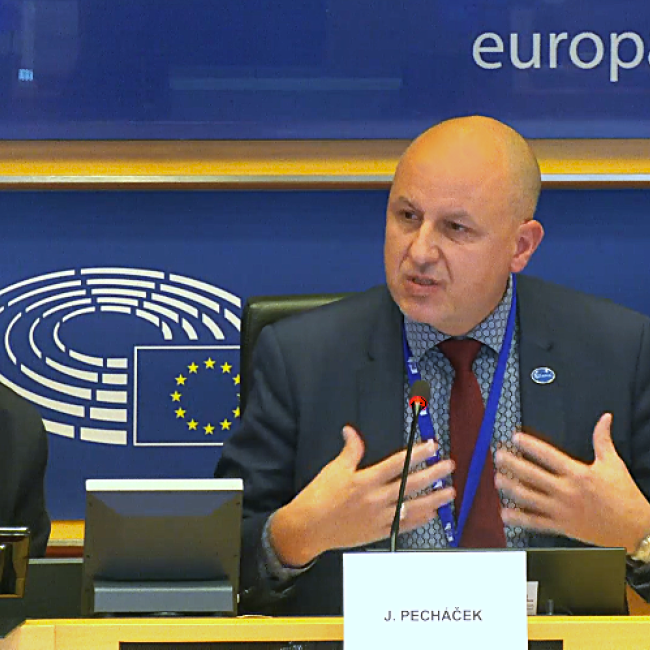
On 4 November, CEPOL’s Executive Director, Jan Pecháček, discussed the Agency’s future plans and strategic outlook during an ordinary meeting of the European Parliament’s Committee on Civil Liberties, Justice and Home Affairs (LIBE) in Brussels.
At the start of the agenda item on CEPOL, he thanked the LIBE Committee for its continued support for the Agency, and its Chair, Mr. Javier Zarzalejos for his positive message on the occasion of the high-level event organised in September to celebrate CEPOL’s 25th Anniversary.
Highlighting the significance of CEPOL’s flagship publication, the EU Strategic Training Needs Assessment (EU-STNA) 2026-2029, Jan Pecháček explained that it lays the foundations for law enforcement training at EU level and will guide the Agency’s activities in the coming period. As part of its future strategic direction, CEPOL will gradually evolve from a training provider into an enabler and coordinator of law enforcement training, building synergies and connecting national and EU capabilities.
The Agency will focus on complementing existing training opportunities, particularly through activities related to the EU toolbox, and a dedicated law enforcement leadership programme. At the same time, CEPOL will maintain its involvement in areas such as fundamental rights, financial investigations and language training, while continuing to fulfil its unique role in the external dimension of EU law enforcement training.
Following his opening remarks, CEPOL’s Executive Director also responded to questions from LIBE members representing different political groups1. The exchange of views covered the following topics:
- CEPOL’s strategic outlook
Addressing CEPOL’s strategic outlook, Mr. Pecháček underlined the importance of the European Commission’s recently published study on law enforcement training in the EU whose findings are expected to inform several strategic changes. These will be discussed, further refined and approved by the Agency’s Management Board in the coming period. As part of this transition, CEPOL is expected to gradually evolve from a training provider into an EU-level coordinator of law enforcement training. Discussions are already under way on a new business model, based on a decentralised network of Centres of Excellence across EU Member States. At the same time, streamlining onsite training activities is expected to free up significant resources for the development of a new digital platform.
- Cooperation with EU Member States
Mr. Pecháček underlined that the Agency works closely with EU Member States, complementing their national training efforts. He emphasised the essential contribution of CEPOL National Units (CNUs) and informed MEPs about addressing regional training needs through tailored learning opportunities for countries facing similar crime patterns and operational challenges.
- Fundamental rights protection
The Executive Director reaffirmed that the protection of fundamental rights is a cross-cutting element of CEPOL’s training offer, mainstreamed across activities for both EU Member States and non-EU partner countries. Emphasising that training on fundamental rights is a shared responsibility between CEPOL and the Member States, he explained that the Agency provides support where needed, while its Law Enforcement Education platform (LEEd) is accessible to law enforcement professionals across the EU.
He highlighted the Agency’s newly developed Virtual Training Centre on Fundamental Rights, which aims to provide a comprehensive online learning approach covering a wide range of topics, including gender-based violence and violence against women.
He also referred to several other initiatives, including this year’s regional onsite training activity on victim protection, the contribution of the CEPOL Exchange Programme to the sharing of good practices, and the Agency’s plans to develop a new blended learning diploma course.
- Cooperation with the Agency’s host country
Referring to Hungary, CEPOL’s host country, Mr. Pecháček expressed his gratitude for its longstanding support and highlighted the positive momentum in cooperation with the Hungarian authorities since taking up his duties earlier this year.
- Training on maintaining law and order at mass events
Regarding training on maintaining law and order in mass events, Mr Pecháček explained that CEPOL has addressed this topic through several activities. However, in light of the findings of the European Commission’s study and the Agency’s evolving role, this area will be de-prioritised, as the focus shifts towards CEPOL’s future strategic objectives.
- Looking ahead
In his concluding remarks, Mr. Pecháček thanked the members of the LIBE Committee for their continued interest in CEPOL and its work. He also underlined that the next two years will mark an important transition period for the Agency, during which CEPOL will evolve and continue to build on its unique strengths.
Watch the full session here: Committee on Civil Liberties, Justice and Home Affairs Ordinary meeting - Multimedia Centre
1 Tomáš ZDECHOVSKÝ, European People’s Party, Czech Republic; Birgit SIPPEL,Group of the Progressive Alliance of Socialists and Democrats in the European Parliament, Germany; Raquel GARCÍA HERMIDA-VAN DER WALLE, Renew Europe Group, Netherlands; Damien CARÊME, the Left group in the European Parliament - GUE/NGL, France.
Related Tags


