




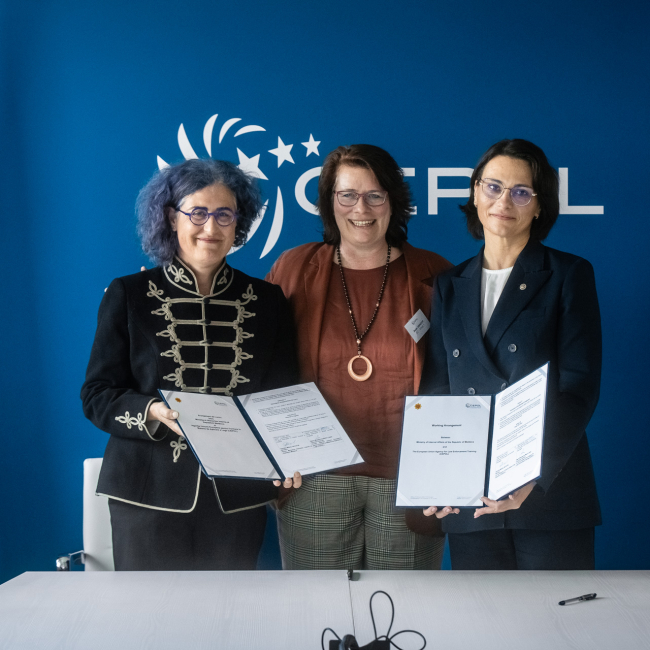
A new Working Arrangement between the Republic of Moldova and CEPOL was signed on 1 April in Budapest. The document, reflecting recent developments, was signed by the Moldovan Minister of Internal Affairs, Daniella Misail-Nichitin, and CEPOL Executive Director, Montserrat Marín López.
The ceremony took place in the margins of the CEPOL new headquarters inauguration and in the presence of Ms Beate Gminder, Director General (acting) of the European Commission’s Directorate General for Migration and Home Affairs.
The arrangement repeals the one that had entered into force on 10 December 2012, and reflects the developments that have taken place during the past decade, including CEPOL’s legal mandate in 2016 and new personal data GDPR requirements. This Working Arrangement will broaden cooperation, increasing Moldovan law enforcement opportunities to attend CEPOL training.
CEPOL’s collaboration in law enforcement training with the Moldovan Ministry of Internal Affairs spans over ten years and contributes to aligning the country’s standards with those of the European Union. Moldovan law enforcement officials have been taking part in CEPOL's training activities to enhance their skills, thus improving cross-border cooperation, while fostering the creation of networks of professionals beyond borders.
In addition, CEPOL is implementing the EU4 Security Moldova project, which aims to improve the operational capacities of the Moldovan law enforcement authorities, while enhancing their education and training, The project is funded by the Delegation of the European Union to the Republic of Moldova.
CEPOL and the Republic of Moldova have also been collaborating since 2020 within the scope of the TOPCOP project, as the Republic of Moldova has been a key partner country since the first phase of the project (2020-2024). The TOPCOP project, which is in its second phase (2024-2028) aims to further enhance operational effectiveness and joint efforts between the Eastern Partnership and the EU, strengthening the strategic and operational cooperation across the region to address criminal threats.
Related Projects

Related Tags


