

 Partners News
Joint efforts in preventing and combatting corruption


Motto: “People should be conscious that they can change a corrupt system” — Peter Eigen, founder of Transparency International.
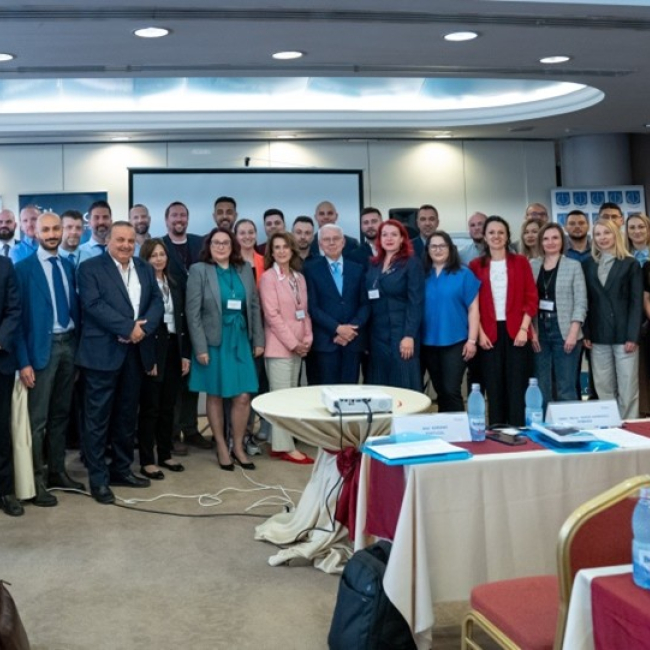
CEPOL course 67/2025 “Investigating and Preventing Corruption”, organised by the Romanian Ministry of Internal Affairs, Directorate General of Human Resources Management, in cooperation with the European Judicial Training Network (EJTN), took place from 2-6 June 2025.
Held in Bucharest, the course was attended by 35 participants from 21 Member States (Belgium, Bulgaria, Cyprus, Czech Republic, Finland, Germany, Greece, Hungary, Ireland, Italy, Latvia, Lithuania, Malta, Netherlands, Poland, Portugal, Romania, Slovenia, Slovakia, Sweden, Spain) and 9 participants from EJTN (Bulgaria, Latvia, Malta, Poland and Sweden), with experts from Europol, EJTN, EPPO, Belgium, Lithuania, the Romanian Public Ministry and the Romanian Ministry of Internal Affairs – the Anticorruption Directorate General (ADG) and Directorate General for Internal Protection.
At the official opening of the course, Mrs. Manuela POPESCU, deputy director general of ADG welcomed the representatives of the Member States and EJTN, mentioning that the activity was of paramount importance especially in the context of international police cooperation. She also mentioned that nowadays activities carried out aim to achieve the specific objectives proposed within the national corruption prevention campaign entitled "It's time for us to stop giving anything!", namely raising awareness among citizens, especially young people, about the phenomenon of corruption and its legal and social consequences, as well as changing the belief that "you cannot get anything done without paying a bribe".

Loading data
During the course, participants learnt about the following topics:
- Best practices in the field of preventing corruption;
- The evaluation of integrity risks;
- Integrity by Design: The Lithuanian Experience in Fighting Corruption;
- Fight against corruption: international cooperation and legal instruments (Presentation and some case studies);
- Investigating and prosecuting the corruption offences related to protecting the financial interests of the EU;
- Introduction to OSINT. OSINT cycle;
- Techniques of OSINT investigations;
- Advanced OSINT;
- Analysis Project Corruption. Handling Whistleblowers;
- Special investigation methods of corruption offences-undercover operations;
- Innovative anticorruption investigations with AI;
- Good practices on seizing electronic evidences;
- Use of digital forensics tools to prevent and combat corruption;
- Financial investigation and information analysis in criminal cases conducted by National Anticorruption Directorate - practical aspects;
- Intelligence analysis, then and now. Intelligence and the intelligence cycle;
- Critical thinking and the elements of an intelligence analysis report. Dealing with different types of data and intelligence;
- Enhancing information gathering by adding analytical methods;
- Intelligence analysis focused on corruption;
- The role of DGIP within Ministry of Internal Affairs. Aspects regarding the prevention and fight against corruption;
- Sports corruption – European initiatives.
Mr. Lorenzo Salazar[1]’s presence to the activity was an added value to the training programme. Some of his remarks refer to the fact that corruption cases are often complex and sensitive. Corruption is by its nature committed in secrecy and difficult to detect and it can be difficult for national authorities to start an investigation. This is further exacerbated by the possible involvement of high-level officials and politically exposed persons.
Loading data
In corruption cases, mutual trust is of particular relevance, not only because of the closeness of cooperation and coordination, but also because of the sensitive and confidential nature of cases. Coordination meetings are a valuable tool for building trust. Joint Investigation Teams (JITs) have become an increasingly important and highly appreciated tool in judicial cooperation, including in cooperation with third states. Third states play a key role in corruption cases. Cooperation with liaison prosecutors seconded to Eurojust has proven essential in corruption cases, enabling the exchange of data and operational information as demonstrated in the ‘FIFA World Cup media rights investigation.
During the training activity the participants had the possibility to exchange their experiences and knowledge in the field of investigating and preventing corruption.
On the 4th of June, the participants paid a visit to the Anti-corruption Directorate General which celebrated 20 years of activity in the service of integrity and legality within the Ministry of Internal Affairs. The results achieved over the years reflect the constant commitment to the law, respect for citizens and efficient collaboration with institutions involved in the field.
Another appreciated topic was the one dedicated to sports corruption, match-fixing being considered a widespread threat to the integrity of sport. Mr Guy Goudesone, the Belgian expert in the field underlined that 90% of gambling is sport related (80% football, 11% tennis, 5% basket and 4% other). After the COVID-19 period, 18 billion EUR were gambled; 90% sport-related means that 16, 2 billion EUR were gambled on sport competitions or events.
In the light of the above, training activities dedicated to investigating and preventing corruption are very important for law enforcement authorities, not only for the information provided, but also for the possibility of networking, sharing best practices and strengthening cross-border cooperation which is particularly important as this phenomenon knows no borders.
Loading data
[1] Deputy Prosecutor General to the Court of Appeal of Naples and Vice-Chair of the OECD Working Group on Bribery
News from partners: Contributions are directly provided by CEPOL partners and published in this section “as is”. As a result, CEPOL shall hold no responsibility in the accuracy of content provided by the partner. Opinions reflected in these news from partners shall not be deemed to represent CEPOL’s Management or staff’s opinion.
Related Tags


