




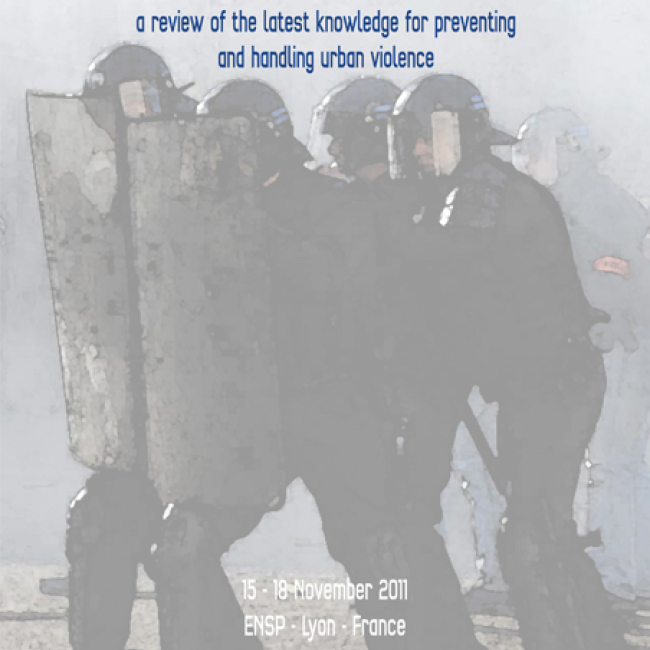
The first CEPOL conference on urban violence was held at the Ecole Nationale Supérieure de la Police (ENSP) near Lyon, France on 15-18 November 2011.
Three French national police services namely the Security and Safety police (DCSP), the riot police (DCCRS), and the Training Department of the Central administration (DRCPN), took part in the preparation and implementation of this pilot activity, with the assistance of the national police college. This activity also benefited from support by the Portuguese Superior Institute for Police Science and Internal Security (ISSPSI) and the Irish Garda Siochana. The activity attracted 25 participants from 13 Member States and Associate Countries.
During the opening ceremony, Hélène Martini, director of ENSP stressed the need for a police exchange at EU level as urban violence now affects several Member States. Jacques Fournier, Central director of the DCSP, explained how recent violent events have brought to important changes in the practice of day to day policing whilst Luc Presson, central director of the DCCRS, highlighted the importance of a well-trained and well-prepared public order police force able to cope with large-scale violent events.
In a very open-minded keynote speech, sociologist and well-known researcher Sebastian Roche, illustrated types of perpetrators as well as motivations and actions related to urban violence in a successful attempt at clarifying concepts and sharing a common definition and understanding of urban violence at an EU level.
Speakers from France, Germany, the Netherlands, Portugal and the UK as well as the participants themselves shared their own understanding and experiences during plenary and breakout sessions, on the following topics:
- Detection and analysis of early signals for a proactive police approach;
- Management of the crisis, i.e.: how to encompass all aspects of police management linked to urban violence such as management of staff, of investigation, of public order and of media;
- Identification of new methods of police cooperation at EU level.
All delegates were enriched by a visit to the Headquarters of the riot police in Lyon. During the tour, participants were shown specific intervention tactics, equipment and special devices such as drones, vision amplifiers and a EC 135 helicopter which was deployed during recent disorders in France. The regional Director of the DDSP explained how human and technological intelligence could lead law enforcers by supporting the decision making process of the civilian authorities.
Evaluation forms completed at the end of the conference reflect the general level of interest that this event generated. A few extracts follow:
- “All topics were well chosen…”
- “It was an interesting exchange because I can take the best experiences from my colleagues from other countries…”
- “I took notice of many experiences I will be able to apply in my country…”
- “I have learned a lot from the discussions about media management…”


